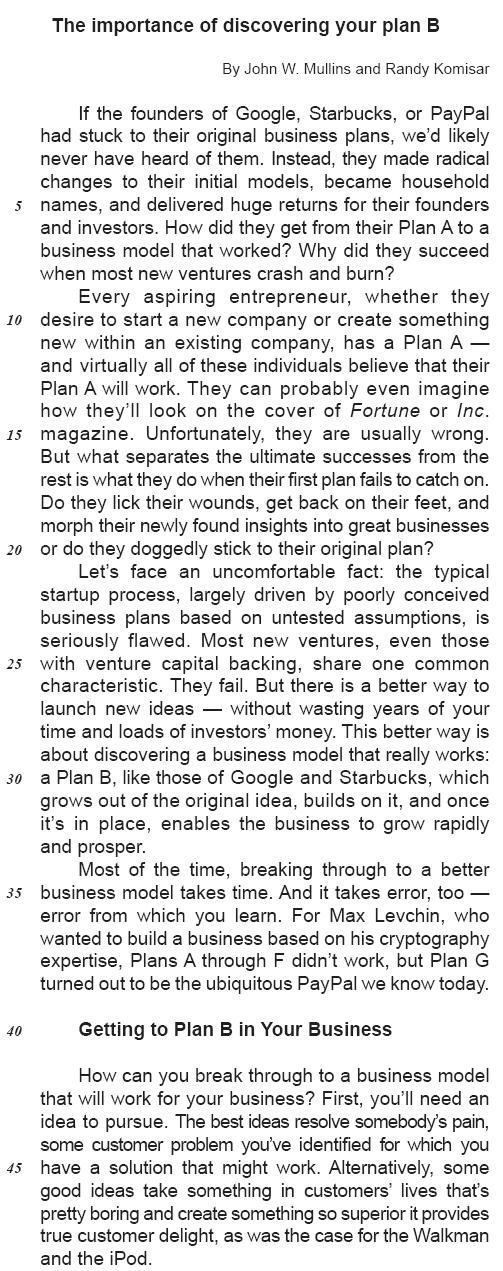
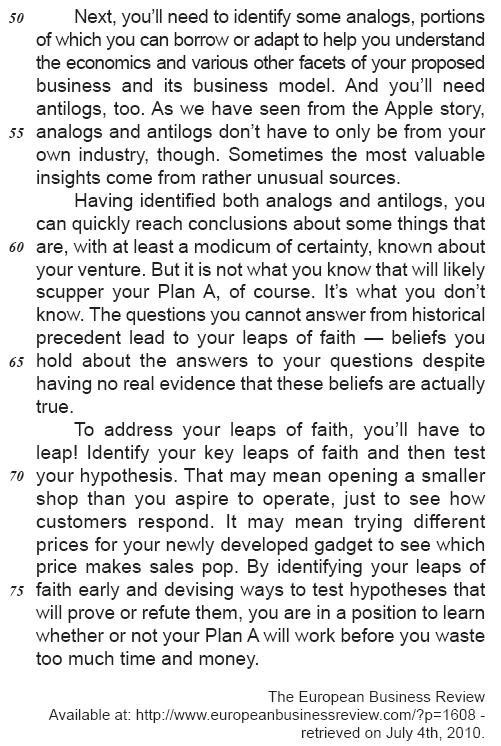
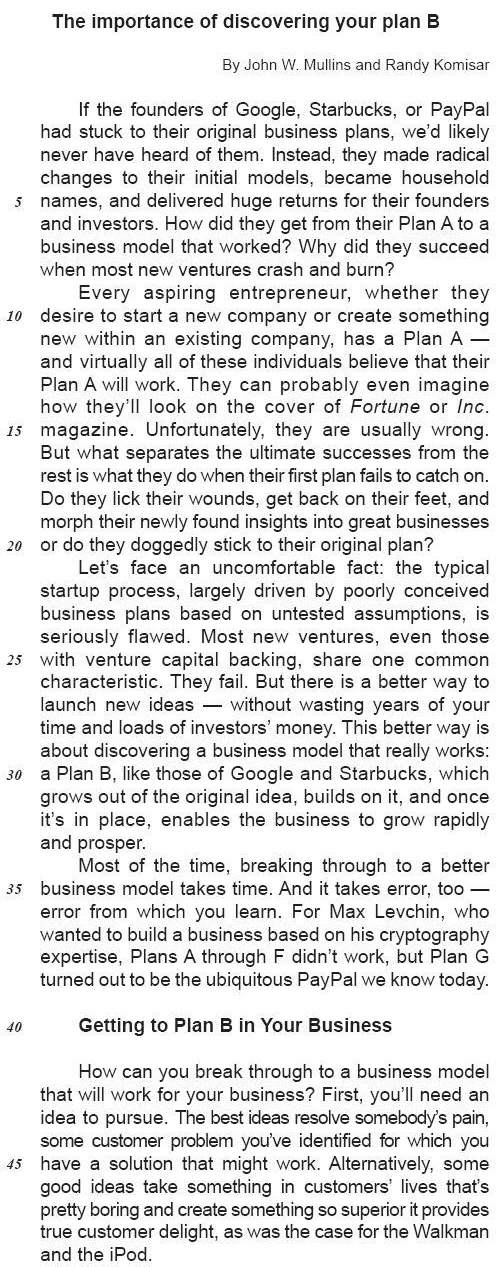
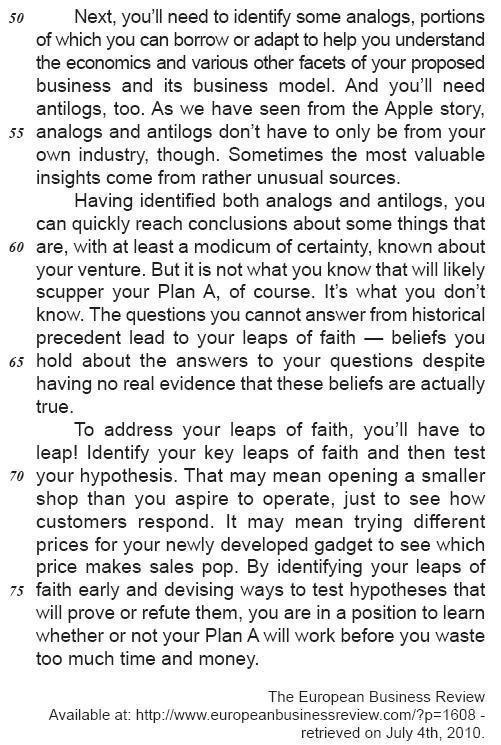
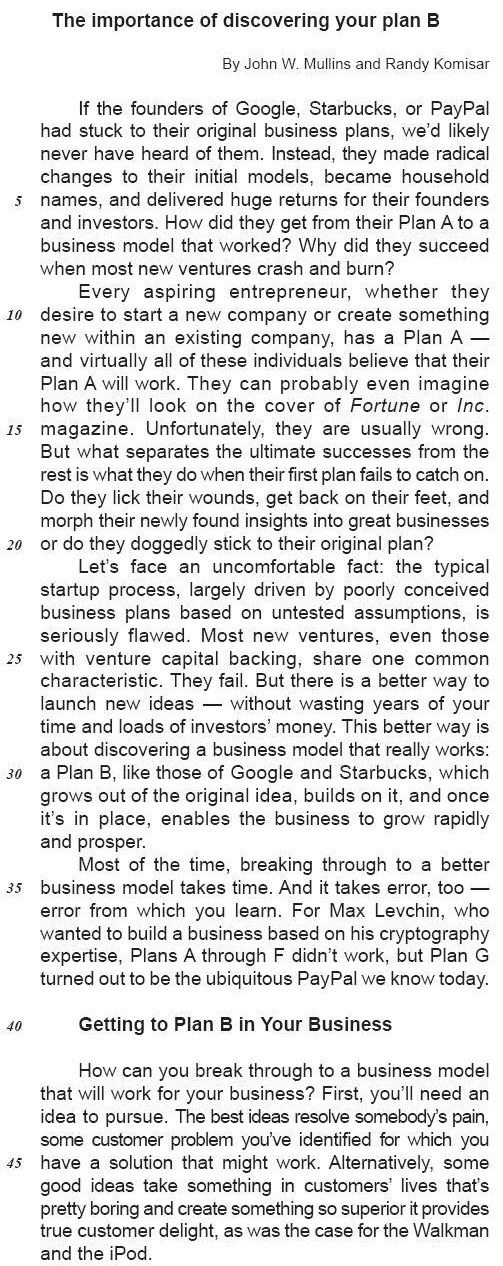
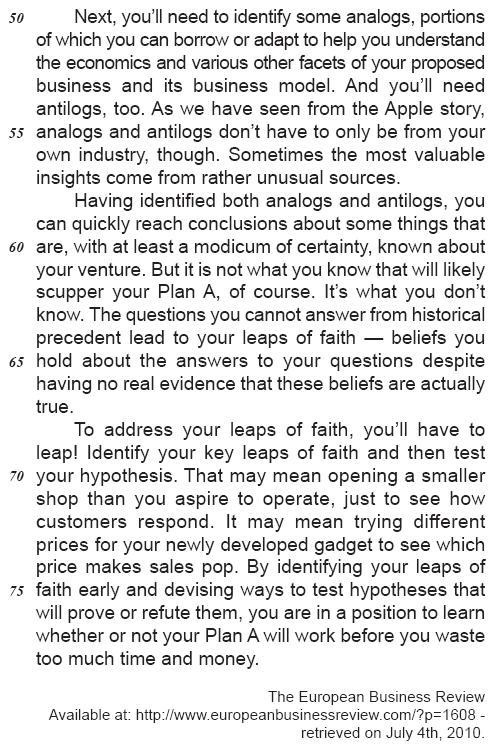
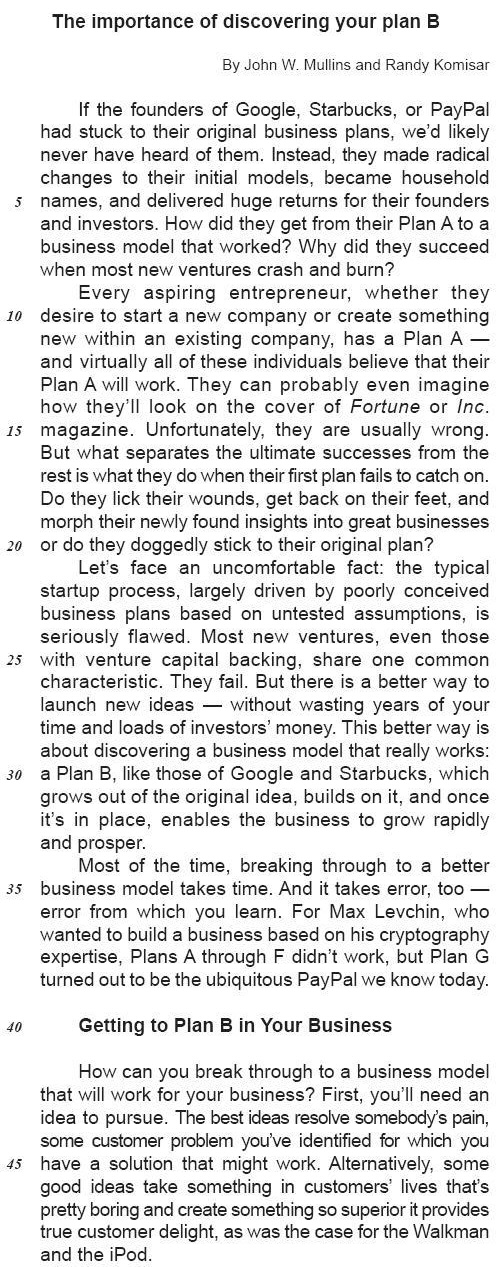
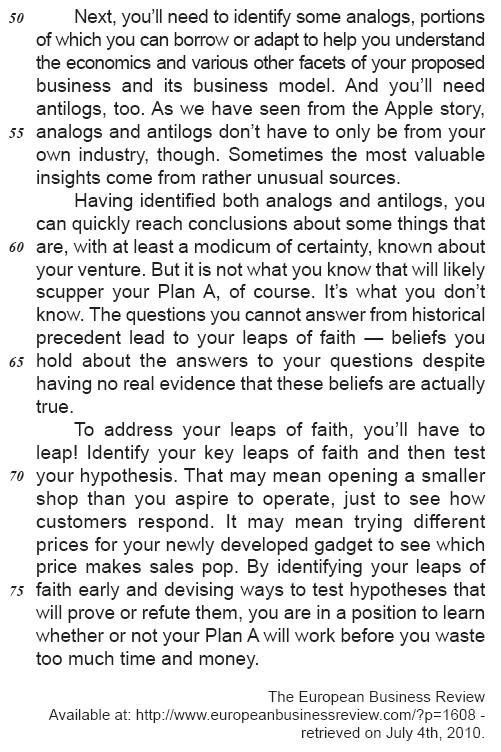
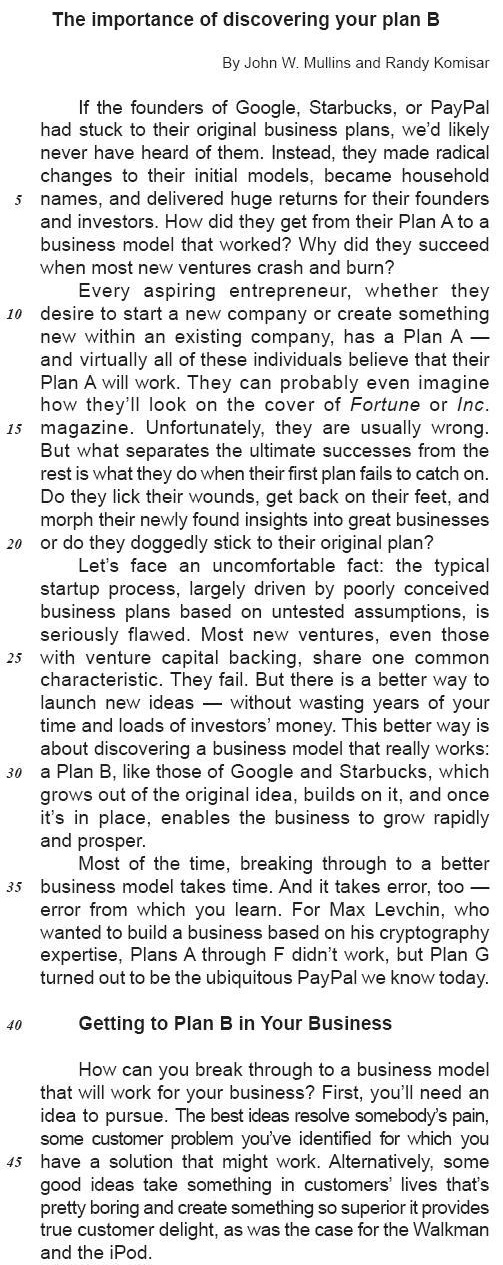
According to the authors,
businesses only prosper if they strictly adopt their Plan A.
most famous companies fail because their leaders never stick to their original plan.
it is necessary to be faithful to the first business plan and wait for customers to respond.
some currently successful companies had to give up their initial plans for alternative business models.
companies always fail when they decide to adopt their Plan B as a shortcut to their original business strategy.
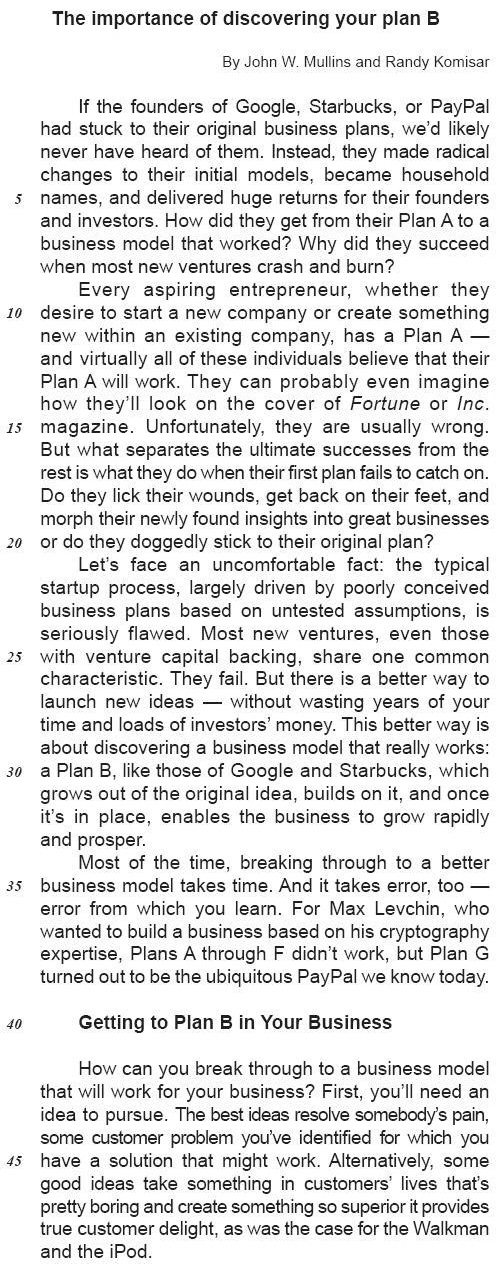
Google, Starbucks and PayPal are mentioned in paragraph 1 (lines 1-8) since they
are the only well-known companies in America nowadays.
represent companies which have never delivered high returns to the investors.
are examples of companies which made significant alterations to their original business plans.
illustrate the kind of businesses that remained loyal to their original plans and fought for results.
have founders who have been on the cover of Fortune magazine and are the world's richest men.
Mulins and Komisar, in paragraph 3 (lines 21-33), state that the typical business startup process is usually unsuccessful because it
does not invest rich sums or waste years on precise planning to design an elaborate business model.
shares common characteristics with traditional businesses that have survived crises.
expects the business to grow rapidly and prosper faster than all other companies in the market.
rejects venture capital funding and does not expect immediate returns.
is based on inadequately designed business plans and on market hypothesis that are not previously tested.
Max Levchin, mentioned in paragraph 4 (lines 34-39), can be considered a(an)
persistent businessman who fought for success.
careless worker who didn't take time to build a business model.
foolish entrepreneur who insisted on opening his own company.
expert in cryptography who failed as a businessman.
impatient investor who did not believe PayPal would prosper.
The term in parentheses expresses the idea introduced by the term in bold in
"Instead, they made radical changes to their initial models," - lines 3-4 (replacement).
"Unfortunately, they are usually wrong." - line 15 (reason).
"Alternatively, some good ideas take something in customers' lives that's pretty boring." - lines 45-47 (cause).
"Next, you'll need to identify some analogs," - line 50 (exemplification).
"beliefs you hold about the answers to your questions despite having no real evidence." - lines 64-66 (consequence).
In the fragments ".their first plan fails to catch on." (line 17) and "How can you break through to a business model." (line 41), the expressions "catch on" and "break through to" mean, respectively,
arrange; find.
work; discover.
capture; give in.
pick up; destroy.
triumph; deteriorate.
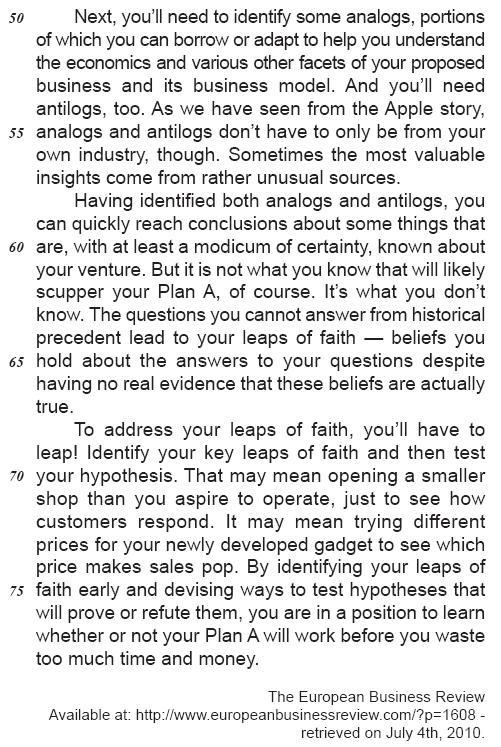
The expression "...leaps of faith" (line 64) refers to
a religious conviction that the business project is definitely going to prosper.
confidence on the various concrete evidences that your business model will surely be successful.
everything you do not know about the returns of your investment and should not worry about.
knowledge about historical precedents that are applicable to your company's current situation.
assumptions about the aspects of the business you propose that are carefully thought of but not tested.
The word "might" in ". you have a solution that might work." (lines 44-45) can be replaced without change in meaning by
must surely.
will certainly.
may probably.
can eventually.
should definitely.
The pair of expressions that express opposing ideas is
"...stuck to..." (line 2) - abandoned.
"...grows out of... " (line 31) - develops from.
"...pursue." (line 43) - follow.
"...scupper..." (line 62) - ruin
"...devising..." (line 75) - elaborating.
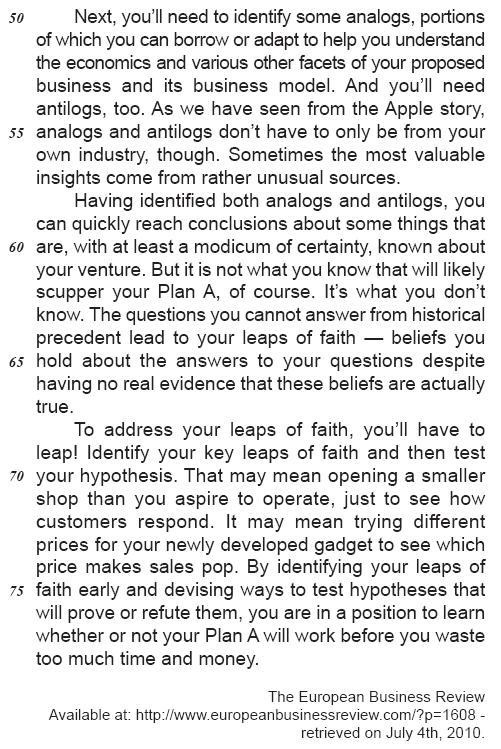
The sentence "It may mean trying different prices for your newly developed gadget to see which price makes sales pop." (lines 72-74) implies that
higher product pricing will certainly lead to more market sales.
sales are determined solely by the characteristics of the gadget.
the most appropriate price should be defined by the competitors.
the cheaper the product is, the more profitable the company will be.
previous testing of price ranges will help find the one which will boost sales.