
Analista Ministerial - Área: Administração - 2024
Responsible state fiscal policy requires more than just balancing the current year’s budget. It must also include ensuring that the budget is on a sustainable path. Otherwise, policymakers cannot have the lasting impact they hope for. This risk is especially high in the aftermath of the COVID-19 pandemic. Record budget surpluses, driven largely by federal pandemic aid, empowered states to adopt historically large tax cuts and spending increases from 2021 to 2023.
State leaders must be able to assess whether their decisions will be affordable over the long term or will jeopardize their ability to solve state problems or even sustain programs and services in the future. Unfortunately, the nature of state budget processes discourages such long-term thinking. State policymakers devote much of their time to developing, enacting, and implementing annual or biennial budgets, a prime opportunity to achieve immediate policy goals.
One key strategy for changing this short-term focus is for states to use long-term budget assessments and budget stress tests to regularly measure risks, anticipate potential shortfalls, and identify ways to address impending challenges. Long-term budget assessments project revenue and spending several years into the future, and stress tests estimate the size of temporary budget shortfalls that would result from recessions or other economic events and gauge whether states are prepared for these events.
Internet: https://www.pewtrusts.org (adapted).
Considering the ideas conveyed in the previous text, as well as its linguistic aspects, judge the following item.
It is correct to conclude from the text that long-term budget assessments and stress tests are two crucial tools for states that seek to establish more than a short-term approach to their budgets.
Responsible state fiscal policy requires more than just balancing the current year’s budget. It must also include ensuring that the budget is on a sustainable path. Otherwise, policymakers cannot have the lasting impact they hope for. This risk is especially high in the aftermath of the COVID-19 pandemic. Record budget surpluses, driven largely by federal pandemic aid, empowered states to adopt historically large tax cuts and spending increases from 2021 to 2023.
State leaders must be able to assess whether their decisions will be affordable over the long term or will jeopardize their ability to solve state problems or even sustain programs and services in the future. Unfortunately, the nature of state budget processes discourages such long-term thinking. State policymakers devote much of their time to developing, enacting, and implementing annual or biennial budgets, a prime opportunity to achieve immediate policy goals.
One key strategy for changing this short-term focus is for states to use long-term budget assessments and budget stress tests to regularly measure risks, anticipate potential shortfalls, and identify ways to address impending challenges. Long-term budget assessments project revenue and spending several years into the future, and stress tests estimate the size of temporary budget shortfalls that would result from recessions or other economic events and gauge whether states are prepared for these events.
Internet: https://www.pewtrusts.org (adapted).
Considering the ideas conveyed in the previous text, as well as its linguistic aspects, judge the following item.
In the first sentence of the second paragraph, the word “jeopardize” is being used with a similar meaning as the one of enhance.
A seguir, a figura I apresenta o conjunto U e três subconjuntos identificados por A, B e C, e as figuras II e III destacam subconjuntos específicos do conjunto U.
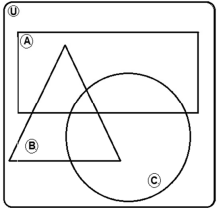
Figura I
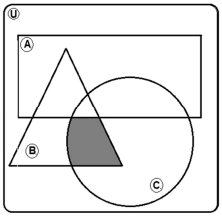
Figura II
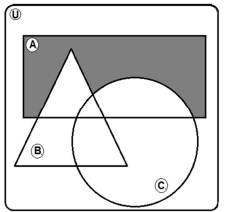
Figura III
Com base nessas informações, julgue o item seguinte, relacionado à descrição dos subconjuntos destacados nas figuras II e III.
O subconjunto destacado na figura III pode ser expresso como [A ⋂ (B U C)c], em que (B ⋃ C)c significa o complementar do conjunto (B ⋃ C) em U.
A seguir, a figura I apresenta o conjunto U e três subconjuntos identificados por A, B e C, e as figuras II e III destacam subconjuntos específicos do conjunto U.
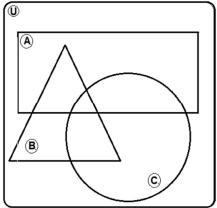
Figura I
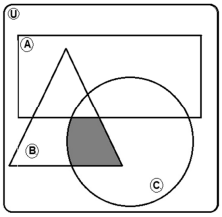
Figura II
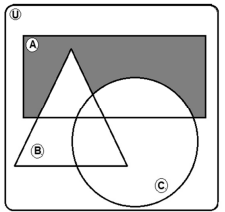
Figura III
Com base nessas informações, julgue o item seguinte, relacionado à descrição dos subconjuntos destacados nas figuras II e III.
O subconjunto destacado na figura II pode ser expresso como [(C ⋂ B) - A].
Julgue o item seguinte, relacionado à lógica proposicional, considerando os símbolos lógicos comuns e as letras maiúsculas como representativas de proposições lógicas simples.
A expressão Q ˄ (~P) é equivalente à expressão ~(P → Q).
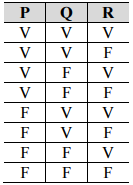
Julgue o item seguinte, relacionado à lógica proposicional, considerando os símbolos lógicos comuns e as letras maiúsculas como representativas de proposições lógicas simples.
Se P, Q e R representam proposições lógicas e as primeiras três colunas da tabela-verdade são as apresentadas a seguir, então a última coluna da tabela-verdade relacionada à expressão (P ˄ R) ˅ (Q ˄ R) apresenta valores V ou F, tomados de cima para baixo, na sequência V, F, V, V, F, F, F e F.
Julgue o item que se segue, relativo a aspectos históricos, sociais e culturais do Acre.
Um traço marcante na estruturação étnica do Acre foi a completa e pacífica inserção dos povos indígenas na sociedade que se estruturava após a incorporação desse território ao Brasil, o que explica a inexistência da hierarquia de classe na sociedade local.
Julgue o item que se segue, relativo a aspectos históricos, sociais e culturais do Acre.
A partir das três últimas décadas do século XIX, o território que viria a ser o atual estado do Acre passou a receber um grande número de imigrantes, particularmente nordestinos, atraídos pelo trabalho nos seringais.
Julgue o item que se segue, relativo a aspectos históricos, sociais e culturais do Acre.
A tradição dos povos indígenas, as manifestações próprias da região Norte e as influências dos imigrantes nordestinos constituem a base da cultura acriana.
Julgue o item que se segue, relativo a aspectos históricos, sociais e culturais do Acre.
Há consenso na historiografia do Acre de que o processo de anexação desse território ao Brasil sempre contou com o apoio, a orientação e o suporte técnico e político do governo central, de modo que a atuação de seus habitantes não foi mais que secundária.