Vade Mecum Digital 2026De R$ 249,90 por 12x R$ 9,99 ou R$ 119,90 à vista
JurisHand AI Logo

Profissional Básico - Administração - 2011

Página 3  •  Total 70 questões
76211Questão 21|Inglês|superior

associated-text-350efb12242eeb66c8e766c8ffa97a0b8fa03c99bfad3115206ceccb5391e695-21-0.jpg

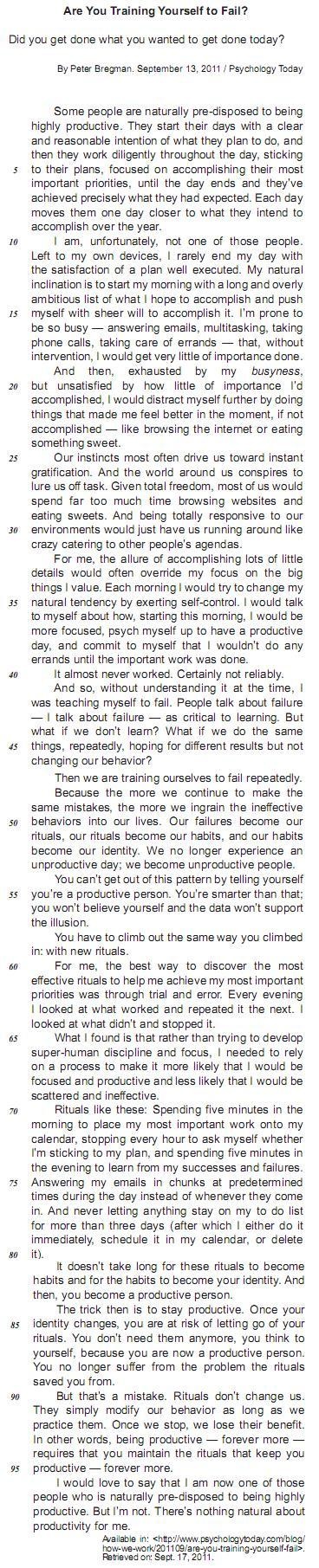
The expression busyness (line 19) is in italics to
  • A

    confuse the reader by referring to all of Peter Bregman’s financial problems.

  • B

    show that the author is not immediately accessible to talk to other people at work.

  • C

    point out that all the author’s enterprises are giving him a succession of bad results.

  • D

    highlight that the author is referring to himself as being extremely full of activities.

  • E

    convey to the reader that Peter Bregman has dedicated himself to the company that he owns.

76212Questão 22|Inglês|superior

associated-text-350efb12242eeb66c8e766c8ffa97a0b8fa03c99bfad3115206ceccb5391e695-22-0.jpg

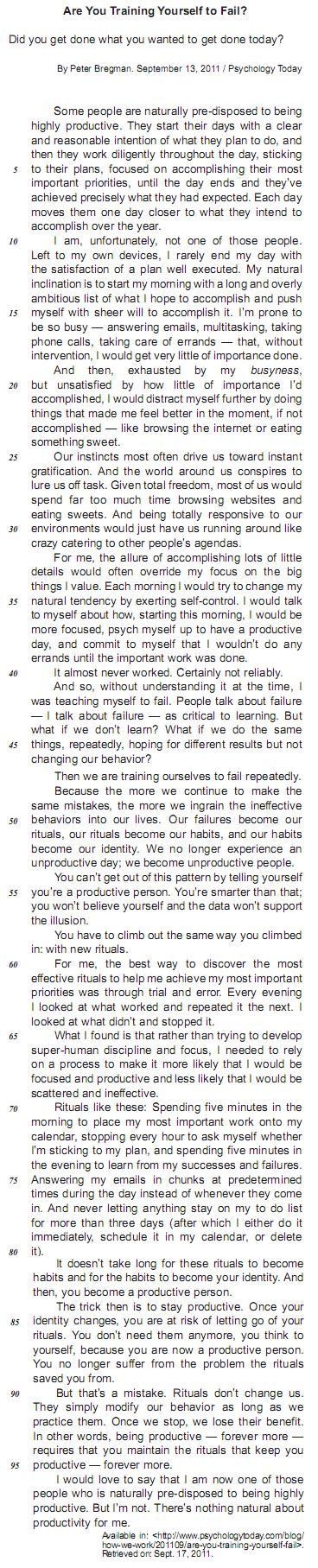
The sentence “It almost never worked.” (line 40) refers to the fact that the author
  • A

    tried to control his impulse of doing irrelevant errands before facing his commitments.

  • B

    had to change his goals to concentrate only on the details of his daily tasks.

  • C

    could never see the relevance of doing important work very early in the morning on weekdays.

  • D

    believes that failure is critical to learning, so it is not essential to control oneself to do the right things.

  • E

    thinks that the world conspires to make people deny their responsibilities and spend their time on leisure activities.

76213Questão 23|Direito Constitucional|superior

associated-text-350efb12242eeb66c8e766c8ffa97a0b8fa03c99bfad3115206ceccb5391e695-23-0.jpg

Based on the meanings in the text,

  • A

    overly (line 13) could be substituted by “moderately”.

  • B

    responsive (line 29) and “insensitive” are antonyms.

  • C

    override (line 33) and “invalidate” express opposite ideas.

  • D

    ingrain (line 49) and “reject” express similar ideas.

  • E

    scattered (line 69) and “concentrated” are synonyms.

76214Questão 24|Inglês|superior

associated-text-350efb12242eeb66c8e766c8ffa97a0b8fa03c99bfad3115206ceccb5391e695-24-0.jpg

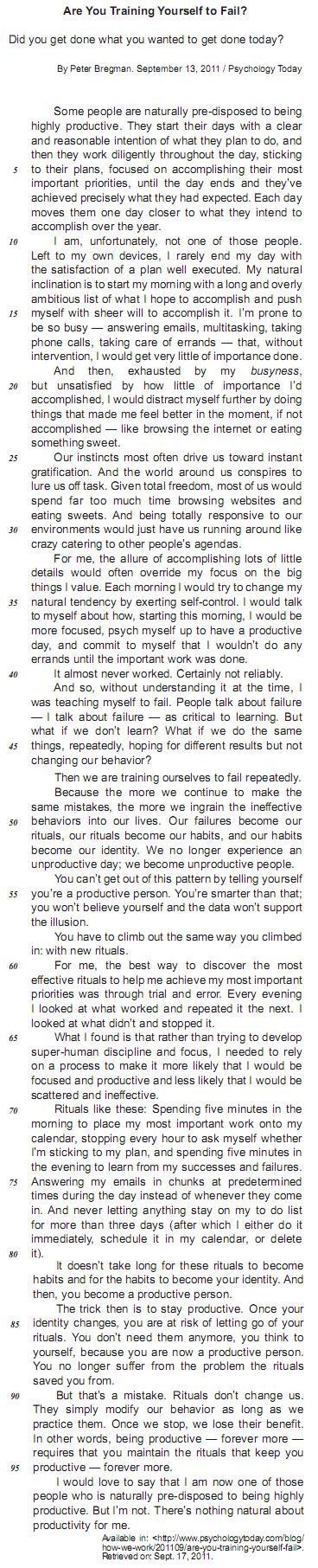
In “Once your identity changes, you are at risk of letting go of your rituals.” (lines 84-86), the author implies that a change of identity
  • A

    will certainly lead to behavioral misconduct and inconvenient daily habits.

  • B

    will force you to be productive and remain so forever, never needing your rituals anymore.

  • C

    will reveal that habits are not part of your identity as an under-achiever in the work environment.

  • D

    can eliminate rituals because they are usually ineffective strategies to achieve successful results.

  • E

    is essential to force yourself to become and remain productive along the days by establishing effective rituals.

76215Questão 25|Inglês|superior

associated-text-350efb12242eeb66c8e766c8ffa97a0b8fa03c99bfad3115206ceccb5391e695-25-0.jpg

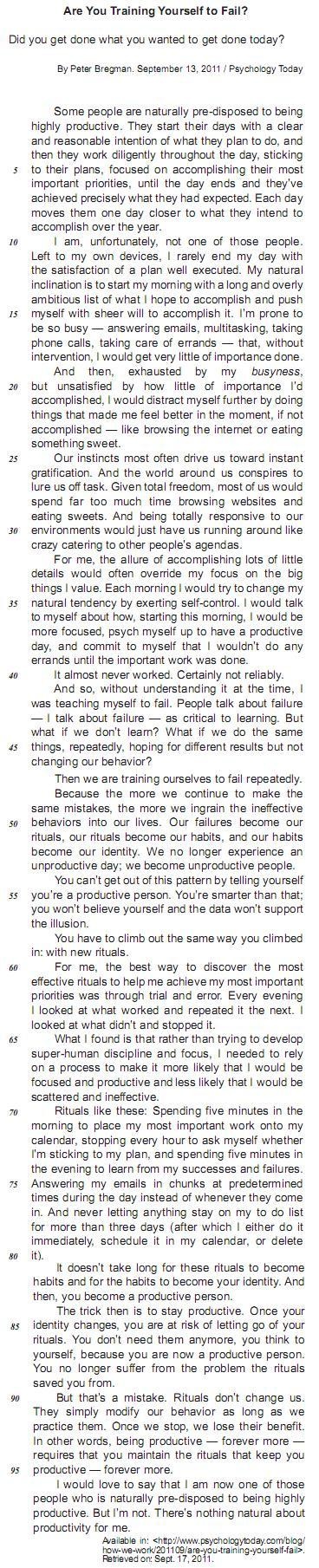
In “Once we stop, we lose their benefit.” (line 92) the word “once” can be replaced, without changing the meaning of the sentence, by
  • A

    Despite the fact that

  • B

    As soon as

  • C

    As far as

  • D

    Though

  • E

    While

76216Questão 26|Inglês|superior

associated-text-350efb12242eeb66c8e766c8ffa97a0b8fa03c99bfad3115206ceccb5391e695-26-0.jpg

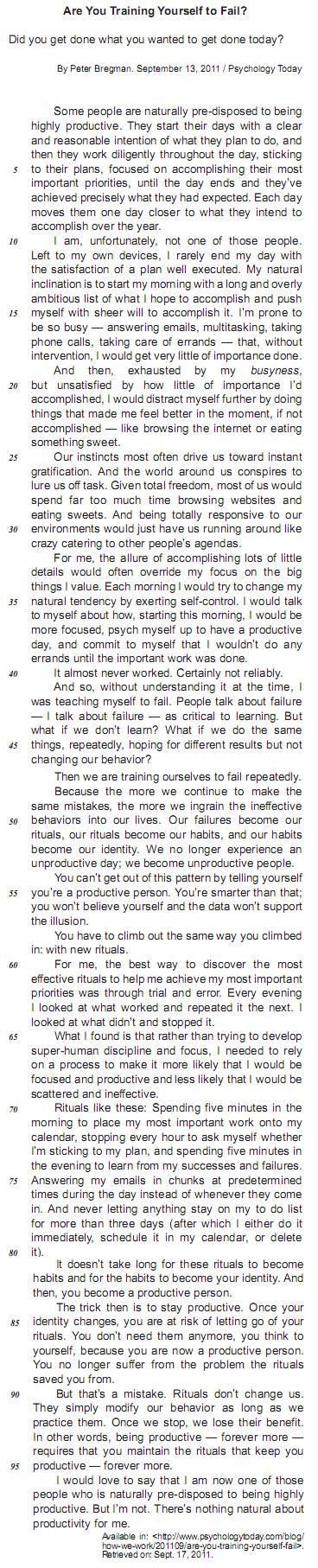
“I’m prone to be so busy […] that, without intervention, I would get very little of importance done.” (lines 15-18) illustrates that the author
  • A

    is constantly distracted from his most relevant goals for the day.

  • B

    leads a very busy professional life with no time for his family and friends.

  • C

    can only fulfill his professional tasks by making use of phone calls and emails.

  • D

    plans to do things that make him feel better before he attempts his daily assignments.

  • E

    has so many household tasks to accomplish that he constantly fails in most of his plans.

76217Questão 27|Inglês|superior

associated-text-350efb12242eeb66c8e766c8ffa97a0b8fa03c99bfad3115206ceccb5391e695-27-0.jpg

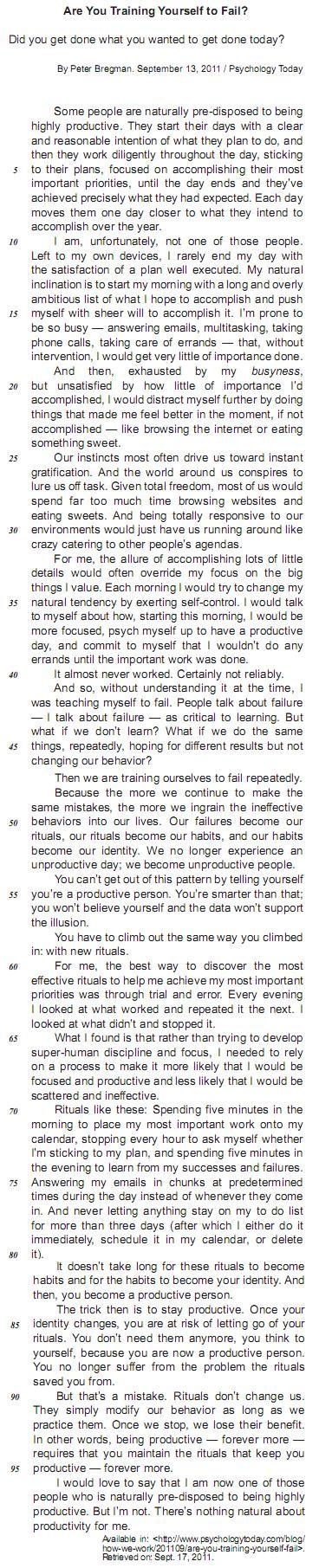
The author ends the text in a tone of
  • A

    high hopes

  • B

    intense anger

  • C

    total conformity

  • D

    extreme satisfaction

  • E

    profound melancholy

76218Questão 28|Inglês|superior

associated-text-350efb12242eeb66c8e766c8ffa97a0b8fa03c99bfad3115206ceccb5391e695-28-0.jpg

In “You have to climb out the same way you climbed in: with new rituals” (lines 58-59) the modal that substitutes ‘have to’ without a change in meaning is
  • A

    may

  • B

    can

  • C

    must

  • D

    would

  • E

    might

76219Questão 29|Português|superior

associated-text-350efb12242eeb66c8e766c8ffa97a0b8fa03c99bfad3115206ceccb5391e695-29-0.jpg

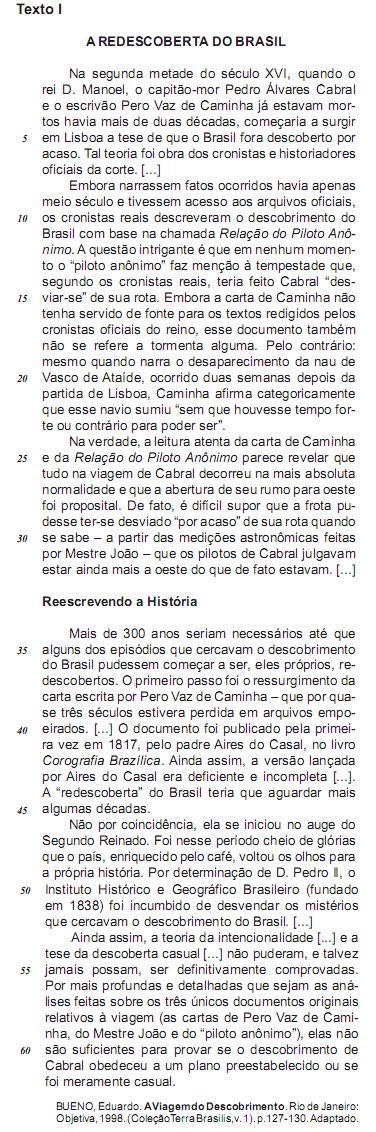
A sentença em que o verbo está corretamente flexionado de acordo com a norma-padrão, sem provocar contradição de significado, é:
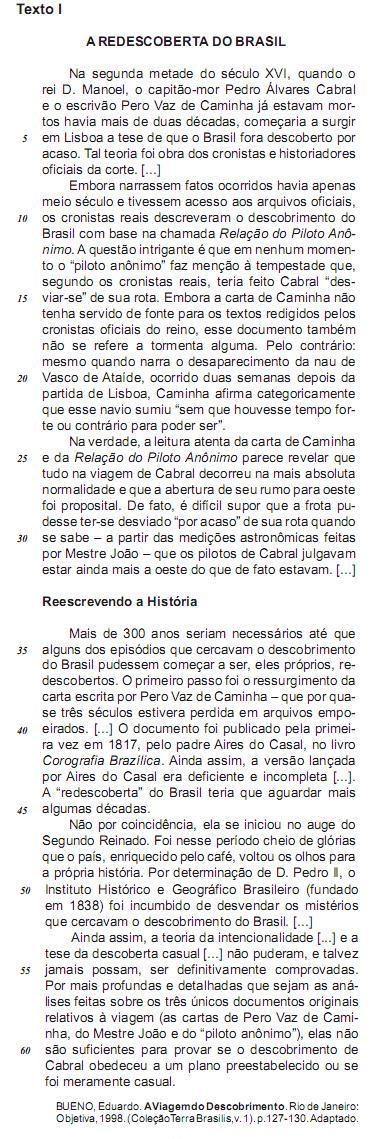
  • A

    O acaso ou a intencionalidade foi a causa da descoberta do Brasil.

  • B

    Haviam 60% de possibilidades de o Brasil ter sido descoberto por acaso.

  • C

    Eu e vocês acreditam na descoberta casual do nosso país.

  • D

    Não gastava a corte tempo com as preocupações que ocupava os historiadores.

  • E

    Devem haver mais evidências para a tese de descoberta casual do Brasil.

76220Questão 30|Português|superior

associated-text-350efb12242eeb66c8e766c8ffa97a0b8fa03c99bfad3115206ceccb5391e695-30-0.jpg

A palavra do Texto I destacada em “[...] faz menção à tempestade que, segundo os cronistas reais, [...]” (L. 13-14) pertence à mesma classe da que se destaca em:

  • A

    “[... ] a tese de que o Brasil fora descoberto por acaso” (L. 5-6).

  • B

    “A questão intrigante é que em nenhum momento [...]” (L. 12-13)

  • C

    “[... ] parece revelar que tudo [...]” (L. 25-26)

  • D

    “– que por quase três séculos [...]” (L. 38-39)

  • E

    “A ‘redescoberta’ do Brasil teria que aguardar [...]” (L. 44)

Profissional Básico - Administração - 2011 | Prova