
Senado Federal - Técnico Legislativo - Policial Legislativo - 2022
Determine quantos retângulos existem na figura a seguir.

Considere a afirmativa a seguir.
(1) “Se tudo der certo, eu viajo amanhã.”
Avalie se as três frases a seguir são negações dessa afirmativa:
I. Se tudo der certo, eu não viajo amanhã.
II. Se tudo der errado, eu viajo amanhã.
III. Se algo der errado, eu não viajo amanhã.
Assim, é correto concluir que:
A quantidade de números naturais que são menores do que 1000 e têm algarismos repetidos na sua representação decimal é
Um tigre avista um javali a 1km de distância e sai, em linha reta, em seu encalço. Nesse instante, o javali foge na direção contrária à do tigre.
O tigre corre a 30m/s, e o javali tenta escapar a uma velocidade de 10m/s.
A distância percorrida pelo javali até ser alcançado pelo tigre é igual a
O gráfico a seguir mostra a estimativa da média do Produto Interno Bruto (PIB) de um país nas três décadas do século XXI. O PIB é dado em bilhões de unidades monetárias (UM) do país.
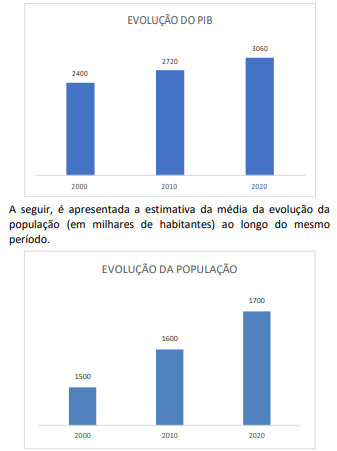
O PIB per capita médio estimado do país nesse período é igual a
Uma pesquisa eleitoral mostra que o candidato A tem a preferência de 42% dos eleitores, enquanto 30% dos eleitores optam pelo candidato B.
Para que os dois candidatos fiquem empatados, a fração de eleitores de A que deve migrar para a candidatura de B, é:
Um clube tem 180 associados que participam de suas duas atividades sociais. Há 130 frequentadores da cinemateca, enquanto 92 sócios participam das aulas de dança de salão.
Sendo assim, é correto afirmar que
Read Text I and answer the four question that follow it.
Text I
Behind the rise of ransomware
The story of the ransomware surge is the story of the discovery, professionalization, and growth of the targeted attack extortion model. Prior to 2016, most ransomware campaigns targeted a large and effectively random pool of end users. This “spray-and-pray” business model privileged quantity over quality, meaning ransomware actors spent less time focusing on how to apply pressure on a given victim and more time trying to reach as many victims as possible. Until the tail end of this period, ransomware did not generate enormous profits. Being a secondtier avenue of cybercrime, it failed to attract as much talent or activity as it would in the years to come.
Ransomware experienced its first period of significant growth between 2013 and 2016, when refinements to ransomware payloads, the emergence of virtual currencies, and enhanced anti-fraud measures from banks and cybersecurity vendors increased the profitability of digital extortion relative to other common avenues of cybercrime. What happened next remains unclear, but with more activity concentrating on ransomware, criminals appear to have learned how easy it was to extort organizations before piecing together how lucrative these attacks could be. Regardless, between 2016 and 2019, established cybercriminal gangs entered the targeted ransomware business en masse.
From that point until the summer of 2021, cybercriminals invested growing time and resources to improve the targeted extortion model. During this period, digital extortion became more profitable because cybercriminal gangs and cybercrime markets reoriented around a near limitless demand for targeted ransomware. Moreover, as criminals learned how to best extract revenue from victims, they launched increasingly disruptive ransomware attacks.
[…]
Even though it is tempting to hope that we are just one diplomatic agreement, one technological leap, or one regulation away from its elimination, targeted ransomware is here to stay. As with other forms of crime, the government can expect better outcomes by planning how to manage the issue over time rather than searching for quick and complete solutions.
Adapted from: https://www.atlanticcouncil.org/wpcontent/uploads/2022/08/Behind_the_rise_of_ransomware.pdf
Based on Text I, mark the statements below as true (T) or false (F).
( ) The “spray-and-pray” business model belongs to a late period in the history of ransomware.
( ) The analysis indicates that cybercrime is far from mushrooming.
( ) The text argues that solutions to cybercrime can be reached in a jiffy.
The statements are, respectively
Read Text I and answer the four question that follow it.
Text I
Behind the rise of ransomware
The story of the ransomware surge is the story of the discovery, professionalization, and growth of the targeted attack extortion model. Prior to 2016, most ransomware campaigns targeted a large and effectively random pool of end users. This “spray-and-pray” business model privileged quantity over quality, meaning ransomware actors spent less time focusing on how to apply pressure on a given victim and more time trying to reach as many victims as possible. Until the tail end of this period, ransomware did not generate enormous profits. Being a secondtier avenue of cybercrime, it failed to attract as much talent or activity as it would in the years to come.
Ransomware experienced its first period of significant growth between 2013 and 2016, when refinements to ransomware payloads, the emergence of virtual currencies, and enhanced anti-fraud measures from banks and cybersecurity vendors increased the profitability of digital extortion relative to other common avenues of cybercrime. What happened next remains unclear, but with more activity concentrating on ransomware, criminals appear to have learned how easy it was to extort organizations before piecing together how lucrative these attacks could be. Regardless, between 2016 and 2019, established cybercriminal gangs entered the targeted ransomware business en masse.
From that point until the summer of 2021, cybercriminals invested growing time and resources to improve the targeted extortion model. During this period, digital extortion became more profitable because cybercriminal gangs and cybercrime markets reoriented around a near limitless demand for targeted ransomware. Moreover, as criminals learned how to best extract revenue from victims, they launched increasingly disruptive ransomware attacks.
[…]
Even though it is tempting to hope that we are just one diplomatic agreement, one technological leap, or one regulation away from its elimination, targeted ransomware is here to stay. As with other forms of crime, the government can expect better outcomes by planning how to manage the issue over time rather than searching for quick and complete solutions.
Adapted from: https://www.atlanticcouncil.org/wpcontent/uploads/2022/08/Behind_the_rise_of_ransomware.pdf
When the author uses the expression “the tail end of this period” (1st paragraph), he is referring to its
Read Text I and answer the four question that follow it.
Text I
Behind the rise of ransomware
The story of the ransomware surge is the story of the discovery, professionalization, and growth of the targeted attack extortion model. Prior to 2016, most ransomware campaigns targeted a large and effectively random pool of end users. This “spray-and-pray” business model privileged quantity over quality, meaning ransomware actors spent less time focusing on how to apply pressure on a given victim and more time trying to reach as many victims as possible. Until the tail end of this period, ransomware did not generate enormous profits. Being a secondtier avenue of cybercrime, it failed to attract as much talent or activity as it would in the years to come.
Ransomware experienced its first period of significant growth between 2013 and 2016, when refinements to ransomware payloads, the emergence of virtual currencies, and enhanced anti-fraud measures from banks and cybersecurity vendors increased the profitability of digital extortion relative to other common avenues of cybercrime. What happened next remains unclear, but with more activity concentrating on ransomware, criminals appear to have learned how easy it was to extort organizations before piecing together how lucrative these attacks could be. Regardless, between 2016 and 2019, established cybercriminal gangs entered the targeted ransomware business en masse.
From that point until the summer of 2021, cybercriminals invested growing time and resources to improve the targeted extortion model. During this period, digital extortion became more profitable because cybercriminal gangs and cybercrime markets reoriented around a near limitless demand for targeted ransomware. Moreover, as criminals learned how to best extract revenue from victims, they launched increasingly disruptive ransomware attacks.
[…]
Even though it is tempting to hope that we are just one diplomatic agreement, one technological leap, or one regulation away from its elimination, targeted ransomware is here to stay. As with other forms of crime, the government can expect better outcomes by planning how to manage the issue over time rather than searching for quick and complete solutions.
Adapted from: https://www.atlanticcouncil.org/wpcontent/uploads/2022/08/Behind_the_rise_of_ransomware.pdf
In “What happened next remains unclear” (2nd paragraph) implies that this period is